Last week I accompanied my coworker Jannet on a field visit to Alebtong, a nearby district. Jannet runs the program for Children with Disabilities (CwD), which entails paying school fees, providing uniforms and other scholastic materials, and supporting families with seeds for food security/subsistence farming and commercial agriculture. CCYA also operates a parallel program for Orphans and Vulnerable Children (OVC).
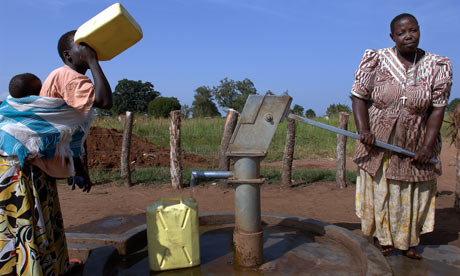
Let's review the situation in which these families live (warning: generalizations to follow): Uganda is a developing country, in the low income bracket. About 30% of Ugandans live on less than $1/day. Poverty is the norm here. This means, among other indicators, that many children walk without shoes long distances to reach a school which may or may not have teachers show up that day. They return home to huts without electricity (so no light by which to study at night), and usually charcoal stoves are used for cooking, giving off much smoke. The average family has 6.65 children. Running water is unlikely nearby, so the women and girls travel by foot (or bicycle if they're lucky) for hours to retrieve it everyday. Hygienic sanitation is rare, mostly just pit latrines without much maintenance. Meals are served at best twice a day, without much diet variation or nutritional value. Risk of water-borne diseases or health problems related to malnutrition is high. Unemployment due to lack of education and skills, along with a lack of export industries, means families have virtually no income.
That's pretty much your standard, run of the mill, sub-Saharan African poverty scenario. Corruption tends to show up in such situations as well, a topic which merits an entire dissertation in and of itself. Grand corruption permeates nearly every echelon of government. Far too often, aid money doesn't reach its intended recipients because it mysteriously winds up in someone's pockets. Monies meant for development projects never appear, even though the books say they should. Meanwhile, President Museveni* has been promoting a campaign to increase the number of districts (roughly equivalent to American states) in order to improve service delivery and accountability. His rationale is that smaller physical areas would increase the ratio of government officials to citizens. Yet during his terms in office, the number of districts rose from 56 to 111, without corresponding results as promised. Alebtong is one of these newer districts, and clearly, drawing new lines hasn't helped anyone, perhaps other than the bureaucrats. In such a corrupt system, increasing the number of government offices seems like it will only increase the opportunities for more corruption.
On top of poverty and corruption, there's another major factor: conflict. The (LRA) conflict took place in this area, and across much of the north. Women and children were abducted, villages decimated, homes displaced, sexual violence committed (and with it the spread of HIV/AIDS), and social ties ripped asunder. Luckily, most IDPs have returned home and rebuilt, and many abductees have escaped and reintegrated into their families and communities. Suffice it to say, widespread trauma still exists, and communities are still recovering from the scourge of war, or, as the locals tend to call it, "the insurgency." Whatever feeble livelihoods families may have possessed before the war were utterly destroyed, and they have had to re-create them from scratch - when they have nothing.
This trifecta of poverty, corruption, and conflict exponentially magnifies the affect of any one single element. Case in point, between the impact of decades of political violence, armed conflict, and low life expectancy associated with poverty, almost 50% of Uganda's population is younger than 15. Whoa.
Enter CCYA, to assist especially marginalized families with basic necessities. With this aid, families can afford to keep their children in school (as opposed to dropping out because of inability to pay fees - by the way, for what is supposed to be universal FREE primary and secondary education), an absolutely crucial component for breaking the cycle of poverty. This can really make a huge difference in the lives of these children and their families, and it is important and valuable work.
But - even if the kids can stay in school, the quality of education is low and opportunities for higher education are even more limited. In rural areas, state education does not produce capable, competent, competitive high school graduates. A billboard around the corner from my house (that I mentioned in a previous post) claims that 256,700 youths cannot find jobs every year -- so even if a student is able to afford university, there simply aren't jobs for all the graduates (hmm, sounds familiar). Ok, that aside - let's say that the family is able to set up a working farm, and they produce enough to meet their immediate needs and sell the surplus for profit. But the roads are in terrible condition, and they don't have any form of transport, and it's a day's walk to the nearest trading center. Getting their goods to market is a significant challenge, but let's say they beat the odds and they make it to the market, eager to sell their good-looking maize.
Well, the next stall over belongs to a family with more money, so they can afford to take their raw maize to a mill and grind it into pretty good quality flour. Processed flour fetches much higher prices than raw maize, which is readily available to a larger portion of the public so it is less lucrative in the market. So the original family comes back home from the market with not a whole lot gained. Maybe they decide they want to process their maize too, to be more competitive at the trading center. But they don't have access to a mill. And they don't have access to credit to build a new mill, because they don't have any savings or other form of collateral. Maybe they'll get lucky and CCYA will be able to help them form a Village Savings and Loan Association with their neighbors so they can set up a revolving credit scheme and eventually raise the capital to build a mill.
Ok, so then they've got an operational mill, and lots of nearby farmers become their clients and they start to turn a profit. Awesome! But - those roads are still really terrible, and it's cost and time-intensive to get to the market to sell their goods. And they want to expand their farm, but to do that they'd need better irrigation systems, which is basically impossible when the nearest borehole (example) is so far away. The government was supposed to pave a better road and dig a closer borehole, but neither has happened yet. Without addressing these larger structural issues -- which one could argue amount to human rights violations -- individual interventions are ultimately limited.
Fortunately, this family knows their rights. They are courageous and won't take no for an answer, and they organize their community to demand that the government fulfills its duty to provide decent public services for them. And they win! Yippee!
Right about here would be a great place to end this hypothetical story, and everyone lives happily ever after. But in reality, of course, it's not this easy. Even if all these elements went as well as we could hope, if a family member falls ill, or drought strikes, or conflict flares back up again, it's all back to square one. I hate to be a Debbie Downer, but this isn't such a hypothetical for many of CCYA's beneficiaries. This sort of chain of events (like Had Gadya or The House That Jack Built) is the reality here, for far too many families.
An undergraduate degree in Politics, Sociology, and Peace and Conflict Studies, seven and a half years of professional experience, one year of graduate school, and about six weeks interning in Uganda, and I'm just starting to scratch the surface of these complexities and challenges. So much still seems way over my head -- solving the problem of poverty seems to be right up there with curing cancer and reversing climate change. I do believe that the rights-based approach to development** (which incorporates a political analysis about the structural and systemic causes of poverty and advocacy/organizing component alongside service-delivery to meet immediate needs), is one of the best tools we have available.
And, it's not enough. Sometimes it's hard to decipher where to even begin: what is the right entry point to create the biggest impact, who are the most strategic stakeholders to engage, when and how? Even if we got all that right, the most organized campaigns are nonetheless limited by the resources available to the duty-bearers. Even if the Ugandan government were a sterling example of honesty and efficiency, if there's simply not enough capital to (fill in the blank here), the community will still suffer.
Big, tough, troubling questions. Just your typical musings during a torrential thunderstorm on a Saturday night in Lira.
I do want to end on an optimistic note, however. I firmly believe in Rabbi Tarfon's credo from Pirke Avot (Ethics of the Ancestors): "It is not upon you to complete the task, nor are you free to desist from it." This summer internship (all three weeks left of it) is not about solving all of the problems of poverty in Northern Uganda, it is about trying to understand them better. I'm don't expect to figure out everything about development during grad school. I doubt that I'll see the end of poverty in my lifetime. Maybe even my future children's lifetime. But I'm still going to keep trying. Because, again, even though paying school fees for a couple of students and providing seeds to their families doesn't solve the entire problem, it sure makes a great big difference in their lives. And that really matters.
*This Wikipedia site is the first that comes up in a Google search for "Museveni". No official state website shows up on the first page of search results at all - check it out.
**Yes, I know this link is really long. But I'm taking entire courses at Fletcher about the RBA, how am I supposed to summarize it in just a line or two?
Sunday, August 5, 2012


Wednesday, July 25, 2012
Meeting, Maize, Maternity, Margharita
Today
started slowly. The weekly staff meeting called for “10:00 am sharp” didn’t
start until 10:45, which was actually less late than other meetings we’ve had,
for whatever that’s worth. Staff meetings are laden with formalities: the
administrator, Brenda, calls the meeting to order and thanks everyone for
coming, then goes over the agenda. This is now the third staff meeting I’ve
attended, and the agenda is exactly the same every time. After this
introduction, there is an opening prayer. Today Brenda put me on the spot and
asked me to lead the prayer. I tried to think of a Hebrew prayer that would be
appropriate for the occasion that I could translate, but nothing came to mind.
I fumbled something about thanking God for bringing us to this day to do the
important work of development, equality, peace, and justice, for all the
resources and abilities we have, and for giving us the opportunity to partner
with the divine in repairing the world. Everyone said “amen” so I guess it went
over ok.
The meeting
proceeded with reports from the chair (Caxson) and the program officers (Denis,
Moses, Ramazan, Joan (actually an intern, and pronounced Jo-ann), and
Christina), followed by a review of the last meeting’s minutes, “reactions and
way forward,” and closing. Again, it is the exact same routine every time. A
sign-in sheet is passed in which we each write our full name, title/role,
gender, and signature. Even if people are missing, the facilitator still says
that “all Secretariat members were present.” Suggestions are made for
corrections to the previous minutes, which may or may not get recorded in the
notes for the current meeting. Everyone formally thanks the person who spoke
before them before offering their own remarks. Within all this formality, I
have noticed a conspicuous lack of eye contact. Even when addressing the group,
oftentimes the speaker will look off in the distance or just keep their eyes on
the paper in front of them. Long silences occur frequently. The peculiar
culture of these staff meetings continues to flummox me.
Later on,
Moses (who sometimes goes by Willy, haven’t discovered why yet) and I got back
to work on a proposal for an income-generation project proposal. We’re applying
to the German Embassy for a small grant to purchase a maize mill and construct
a building to house it in a rural village. This village hosted many IDPs during
the height of the LRA conflict, despite already limited resources. Though all
the IDPs have left, the village is still recovering from the intense strain.
Because returned IDP communities have received lots of attention and support
from NGOs (local and especially international) and some government programs,
those villages are now in better shape than this host community, which was
actually spared from damage during the conflict itself. So, this community,
Aluka village, has significant unmet need – income generation from a local
maize mill business could substantially improve their situation. I’ve been
geeking out on creating a theory of change for this project and getting into
the details of project design, including identifying indicators for success to
be utilized in future monitoring and evaluation. So far this has been the best
part of my job.
Moses is the
finance person so he’s tasked with figuring out the budget for the project. To
do that, we needed info on the cost of running a maize mill. And it just so
happens, that right on the same plot of land as our office, there is a maize
mill (which I never noticed before – nor did I notice the sign for it across
the road). The owner, a young woman named Susan, sat down with us to talk shop.
(Presumably) her children were milling about (ha, get it? milling!) curious to
catch a look at me. I’d wave at them and they’d giggle. Eventually they made
their way closer to me and one was bold enough to touch my skin, pet my hand,
and poke my rings. Sometimes I made funny faces at them and waved more, but
mostly I tried to pay attention to the conversation with Moses and Susan. And
then, when they least expected it, I’d reach out and tickle the kids to their
great delight. Eventually they’d burst into peals of laughter even before my
fingertips reached their dusty bellies.
After
gathering the info we needed (how many workers does she employ, at what wage/benefits
and how many hours; how many kilos of maize can the mill grind per hour; what
is the charge per kilo; total monthly costs, etc.), I asked to see the mill.
For a couple of weeks now we’ve been working on this proposal and I’ve had
absolutely no idea what a maize mill looks like, how it works, how big it is –
nothing. I’ve been picturing something like a grist mill on a waterfall with abig wheel spinning. Well, spoiler alert, that’s not at all what a maize mill
looks like! It is much much smaller. What was most remarkable, though, was that
absolutely everything in the building was covered with some kind of
flour-paste-dust-web. It almost looked like dough had been thrown all over the
place and then dusted with more flour. And it smelled like dough, too, all just
from the mass quantities of corn flour processed there. I’ll try to post a picture of it soon, but in the meantime here's an approximation.


When we got
back to the office, we ran the numbers and found that even if our project only
operates at 40% capacity, the village could net almost ten million shillings
within three years, which is really wonderful and would make a huge difference
in their lives. They’d be able to afford school fees for their children, access
private health services (government clinics are notoriously bad), purchase more
resilient housing materials, and so on. Testing the various contingencies of
the budget made me realize I actually did gain some new skills from agonizing
over cost-benefit analysis spreadsheets in my first semester “Analytical
Frameworks for International Public Policy Decision-Making” class. Go figure. (Thanks,
Professor Gideon.)
Meanwhile,
at the end of the staff meeting, Jannet asked to enter into the official
minutes her congratulations for Moses on becoming a father once again on
Sunday! I knew that Moses’ wife (incidentally, also named Janet) was VERY
pregnant, but I had no idea she was so close to delivering. I didn’t hear
anyone else at work talking about a birth, at least in English, and Moses never
mentioned it yesterday or this morning. This is particularly strange because I
stayed late at the office last night with Moses during a thunderstorm. His kids
kept on coming in to talk to him and/or shyly look at me and wave. I pulled his
daughter Mercy onto my lap to color on my desk while Moses told me the story of
uncovering the circumstances of his father’s death (a story for another post).
His son Daniel kept trying to take the pen so he could draw too. All this
family time and talk, and no mention of a brand new baby. Curious.
Anyway, Janet
lives in a hut behind our office/house with their family and often brings food
to the office (fruit, roasted maize, porridge) or brings me lunch. I’ve never
asked her for this and sometimes I feel guilty taking it because she already
has four children and limited means; I feel bad taking away from her family’s
food, especially because I can so easily buy my own. But my coworkers have told
me that this is her way of making me feel welcome, so it’s ok for me to take
it; in fact, it’s important that I accept it. I’ve been thinking that I should
pay her, but that seems awkward. I mentioned this dilemma to a Peace Corps
volunteer, Rachel, I met in town last week. Rachel suggested bringing
groceries/fresh produce to her instead, and asking her to show me how to cook.
I loved this idea, and actually mentioned it to Janet on Friday. She laughed
and I wasn’t sure if she understood… and then today I found out she was already
having contractions when that conversation took place.
After Moses
and I finished at the maize mill, I asked if I could meet his baby. He led me
to the hut and then disappeared back into the office before I even realized he
was gone. (Come to think of it, I don’t think I’ve ever really seen them interact.
Hardly ever with his kids, either.) Within the hut, which was much more
spacious and bright than I expected, Janet was sitting on the floor, wearing
the same dress she usually does, washing clothes and sheets by hand. If you
didn’t already know she’d just given birth, you’d never be able to tell from
the scene. She got up to get me a chair. SHE, who just gave birth, got ME, a
fully capable individual, a chair. Besides the washing, she also had a pot of
cassava boiling on the charcoal stove in the hut (which gave off lots of smoke,
apparently not of much concern). I asked to see the baby and she brought out a
completely wrapped bundle of blankets with a two-day old boy inside. He has
lots of soft black hair, light brown skin, an impossibly cute chin, and teensy
tiny fingernails. He stayed asleep, stirring a bit, raising one arm above his
head. I held the baby for a while, kvelling and just marveling at his miraculous
tininess and his mom’s strength and energy.
Janet explained
to me and another visitor, Harriet, that she had been in labor for three full
days. Moses, however, was in “the village” (which I think means his home
village, (where I visited a few weeks ago for a traditional marriage ceremony!)
but I’m not sure). Eventually she went to a neighbor for help in getting to the
hospital to deliver, and traveled there by motorcycle. The image of a woman in
labor on the back of a motorcycle is rather astonishingly amazing to me.
Luckily, she made it in time – she was admitted Saturday night and the baby was
born Sunday. Moses did not return until after the baby was born. They still
have not decided on a name.
With all the
latest hoopla back home over whether or not women can have it all, here in
front of me was a Ugandan woman who is right back to running her household
without a moment’s pause. More and more I’ve been thinking that our Western
luxuries have weakened us. We don’t get nearly as much use out of our bodies as
people do here. We rely on machines and technology and external resources,
rather than our own physical selves. Women here strap their babies to their
backs with large pieces of cloth (no strollers), balance significantly large
and heavy items on their heads (no roller bags), and ride a bike (very few
cars) all at the same time. Hand-washing (no washing machines) and hand-grinding
(little pre-processed food) actually take a lot of muscle. Men push massive
loads on bikes, wheelbarrows, you name it. Perhaps it’s just the spaces I
frequent, but I rarely see such demonstrations of brute strength at home. Toddlers
ride on the back rack of bikes, just holding onto the end of the seat. I think
that toddlers might even start walking sooner here, just out of necessity. I’m
not advocating for putting small kids in unsafe situations, but I wonder if we Westerners
tend to coddle children more than is really necessary? Are the material
solutions to our perceived problems actually burdening us even more? Are we
just lazy and looking for excuses? No disrespect at all to any parents out
there, I’m just struck by the self-sufficiency and resourcefulness I’ve seen
here. Interesting contrast to ponder.
I definitely
want to see more of this baby, and I’d like to bring a gift for Janet and Moses.
Any suggestions, readers?
One other highlight of the day came when I started being a Jewish mother to Caxson. He has "flu and cough" and sounds awful. He hadn't eaten anything all day so when another one of Moses' kids brought us lunch, which Janet (wife, not coworker) cooked, I insisted that he eat. I also explained that since my family all works in health and medicine, I feel authorized to dispense medical advice, so I insisted that he take two panadol/tylenol too. After he ate, he said, "Jocelyn, thank you for encouraging me to eat. Otherwise I would have not known that this food is so de-li-ci-ous!" And so I kvelled some more.
Today’s
events ended with a goodbye dinner for Jasmine at the nearby Margharita Palace
Hotel. Under the light of CNN International on the wall-mounted television, we
toasted our Smirnoff Ices and wine to this time we’ve shared in Lira as the
Fletcher Foursome (well, one honorary Fletcherite) and wished her well on the
next phase of her summer adventure.


Monday, July 23, 2012
Back to Basics
Winston Churchill dubbed Uganda, "the Pearl of Africa." Now that I've been here for just over a month (and exactly five weeks to go), it is high time to fill in some general observations I've collected so far, in no particular order:
I. Ugandan phrases/idioms
- When called (to enter a room, for example, or on the phone): "Yes please?"
- To greet someone into a space: "You are (most) welcome."
- Whenever something drops, someone trips, any small accident occurrence: "sorry sorry!" (as in, if I drop my bag, someone else will say "sorry sorry!")
- Referring to another location far away: "that side," or nearby, "this side"
- Referring to an indeterminate time in the past: "those days" or "at that time"
- "Flashing" is when you call someone and hang up right away so they'll call you back - which makes the call free for you. (Apparently the US is one of the only places where cellphone companies charge to receive calls and texts!)
- Electric outlets: "ports" (and they usually have an on/off switch - much more energy efficient!)
- Electrical outage: "power shedding"
- God bless you: "Obanga mi goom"
- How are you? / I'm fine: "Kopango?/ Ko-peh"
- Phrases/sentences are punctuated with "what?" - as in, "I will go to the market for what? For passion fruits (which are AMAZING, by the way) and beans."
- Here in Lira, I've seen ads mostly for beer and paint. There are tons of paint ads everywhere I've been so far - billboards, on walls and fences, shops. One company, Sadolin, has a series of ads for their many shades of paint that says "when it has to be _________" - variations include cherry, peanut, and lime. There's also a Berger paint company with occasional ads around!
- By far the most frequent format for ads is in shop signs, which makes it looks something like "Coca Cola presents: Jocelyn's Grocery."
- Large billboards are vertically/portrait orientated, rather than the horizontal landscape version more common at home. There are not that many of the large format ones here, especially not in town itself, though right outside of town on the larger roads leading in and out, there are a few. Around the corner from my street there is a large billboard with a picture of a young woman in a cap and gown with red, yellow, and black war paint-like stripes on her face, looking very sad. It says something about many tens of thousands of youths graduate every year without a job - combat unemployment through family planning. This ad is sponsored by USAID.
- In Kampala there are more frequent large billboards, many of which have messages about safe sex/HIV prevention, banks, mobile phone providers, and a few political ads. I also saw one for the Ugandan national football (soccer) team where the players look very fierce and it says "this is war!" - which I thought was too much, too soon. There's also one from the National Electoral Commission that says "Power is the People's. We are all Ugandans, voting should not divide us. Reject Ignorance. Analyse and vote." (Although I think this is meant to decry election violence, another interpretation could be that the ruling party just wants all the votes.)
- At home it bothers me to be surrounded by so much consumerism and marketing all the time, but seeing the dearth of ads, it seems to be an area for significant private sector growth and potential revenue.
III. Roads
Dusty. Bumpy. Narrow. Unpaved in rural areas. Many others are partially paved and full of potholes. For a cars to pass, on many roads, one must pull over to the side, basically off the road completely. No shoulder to speak of, and very few sidewalks.
- The roads in Lira are much more manageable and navigable than in Kampala, thankfully - since I ride a bike about 3.5 kms to work every day. Roads are occupied by large trucks, smaller pickup trucks sometimes piled with innumerable people, cars, shared van-taxis (mutatu), motorcycles (both private and for-hire), bicycles (also both private and for-hire), people pushing wheelbarrows, and pedestrians - many of whom are women with babies strapped to their backs, carrying large parcels on their heads.
- Such parcels include, but are not limited to, buckets full of prepared food (such as fried bread or chicken, or chappatis), g-nuts (groundnuts aka peanuts), maize, or cassava; jerry cans full of fuel or water, sewing machines, and reams of fabric. Items strapped to bikes or motorcycles include but are not limited too: live animals (today I saw a pig), lumber/timber, enormous sacks of dry goods, rolled-up foam mattresses, and furniture.
- Large trucks and shared vans often have slogans written across the front or back windshield: "Jesus Christ Born Again," "Mashallah," "Oldies are Goodies," "Please Keep Time" (particularly ironic considering the flexible concept of time prevalent here), and "Covered by the Blood of Jesus." Personally, I'm covered by Aetna.
- Sights on the side of the road: welders wearing great big alien-eye sunglasses, merchants grilling maize or chappatis for sale (and sometimes 'rolexes' - a chappati wrapped up with an omelet inside, the Ugandan version of a breakfast burrito); parked wheelbarrows full of packets of laundry soap/toothpaste/random assorted plastic containers for sale/mobile airtime; loads of boda (bicycles or motorcycles for hire - a boda from my house to the center of town is about 2000 shillings, or 80 cents) drivers waiting for their next fare; curtains tied to fences for sale, blowing in the breeze; and puddles. In Kampala, where there are some full sidewalks, I saw women sitting in the shade of their newspaper stands, selling the daily headlines. What strikes me most on the roads, though, is the absence of beggars, and the profusion of people ready to smile and say hello, good morning, how are you. I like that part a lot.
IV. Assorted Items
- Lots of second-hand western clothes for sale and worn here. I've seen people wearing t-shirts from Stanford and Camp Tamarack, a Cleveland Indians hat, and little girls wearing shirts that say "I'm cute 24/7" and "Someday I'll be the Boss of You." !
- Vehicles keep their engines on while filling up with petrol.
- There are tons of butterflies everywhere! Amazing!
- Most cars are Toyotas, many of which look just like the ones we have at home, just with the steering wheel on the right. One that looks a lot like a Camry is called Corona, another one is called Ipsum.
- Toilet paper roles are sold individually packed, and the beginning of the paper does not adhere to the roll.
- Light switches work in the opposite direction.
- Padlocks are more common than locking doorknobs.
- ATMs are usually in a little booth, not just open against a building.
- Garbage is burned, not collected. The smell of fires burning is constant.
- Geckos are everywhere. One lives in a little window in my room.
Thursday, July 19, 2012
On Travel
Interesting piece from the NY Times on meaning, romance, and myths of travel:
http://opinionator.blogs.nytimes.com/2012/07/07/reclaiming-travel/
The constant tension within travel as an exercise in self-sufficiency versus dependence on others mentioned in the article really resonates for me. Sometimes I want more hand-holding, I want to be led around to learn and see and experience. Other times, I want to be able to do things on my own. Case in point, I bought a bike here so I wouldn't be dependent on others for transportation. (In part, the bike example is a resource issue - I knew it would be more taxing for my organization to provide transportation for me every day than it was for me to buy a bike of my own, and I don't want to use up more resources than necessary.)
The line between loneliness and independence is fuzzy.
This tension feels particularly exacerbated here by the tendency of adults to leave me alone, in accordance with the cultural norms of honoring guests with their own space, peace, and quiet (as I understand them*). So whereas I'd prefer to spend time with people, building those important relationships I mentioned in the previous post - such as during my lunch hour at work - I am (sometimes) invited/instructed to enjoy the solitude of my office instead. The presumption of that preference, perhaps, is related to differing concepts of personal space between American and Ugandan culture? Unsure.
Children, on the other hand, tend to be more bold - they want to check out the munu (the Luo version of mzungu, the common Kiswahili word for white person, exotic, foreigner), shake my hand, learn my name. Many times, if they can come close to me, they do. And I love it! (well, most of the time) Adults seem to keep their distance more, at least in this professional setting. Of course, there are also variations across these groups, across genders, across settings.
Certainly, I admit, my own agency is relevant here as well - this is a two way street. I can't just sit around and wait for locals to come engage with me and feel upset if they don't. Yet sometimes it feels like an imposition - they didn't (necessarily) ask for me to come into their space, interrupt their routines with questions, conversations and distractions. I don't want to burden others, I don't want to intrude.
But - on some level, that's what travel is, right? An intrusion, not necessarily invited. No one asks to be a tourist attraction. As the article posits: "Travel is a search for meaning, not only in our own lives, but also in the lives of others. The humility required for genuine travel is exactly what is missing from its opposite extreme, tourism."
So, how do I get there? Balancing my inquisitiveness and natural extroversion with respectful limits and culturally appropriate behavior is an ongoing dance this summer, and beyond.
*Disclaimer: I am not an anthropologist or cultural expert of any kind. These posts are full of my own assumptions, generalizations, and projections. As they say - we see things as we are, not as they are. So, I recognize that there are likely exceptions to many of these statements, they are subjective and often rife with stereotypes. I am just trying to make sense of things as I go along, with as much sensitivity and curiosity as I can muster.
http://opinionator.blogs.nytimes.com/2012/07/07/reclaiming-travel/
The constant tension within travel as an exercise in self-sufficiency versus dependence on others mentioned in the article really resonates for me. Sometimes I want more hand-holding, I want to be led around to learn and see and experience. Other times, I want to be able to do things on my own. Case in point, I bought a bike here so I wouldn't be dependent on others for transportation. (In part, the bike example is a resource issue - I knew it would be more taxing for my organization to provide transportation for me every day than it was for me to buy a bike of my own, and I don't want to use up more resources than necessary.)
The line between loneliness and independence is fuzzy.
This tension feels particularly exacerbated here by the tendency of adults to leave me alone, in accordance with the cultural norms of honoring guests with their own space, peace, and quiet (as I understand them*). So whereas I'd prefer to spend time with people, building those important relationships I mentioned in the previous post - such as during my lunch hour at work - I am (sometimes) invited/instructed to enjoy the solitude of my office instead. The presumption of that preference, perhaps, is related to differing concepts of personal space between American and Ugandan culture? Unsure.
Children, on the other hand, tend to be more bold - they want to check out the munu (the Luo version of mzungu, the common Kiswahili word for white person, exotic, foreigner), shake my hand, learn my name. Many times, if they can come close to me, they do. And I love it! (well, most of the time) Adults seem to keep their distance more, at least in this professional setting. Of course, there are also variations across these groups, across genders, across settings.
Certainly, I admit, my own agency is relevant here as well - this is a two way street. I can't just sit around and wait for locals to come engage with me and feel upset if they don't. Yet sometimes it feels like an imposition - they didn't (necessarily) ask for me to come into their space, interrupt their routines with questions, conversations and distractions. I don't want to burden others, I don't want to intrude.
But - on some level, that's what travel is, right? An intrusion, not necessarily invited. No one asks to be a tourist attraction. As the article posits: "Travel is a search for meaning, not only in our own lives, but also in the lives of others. The humility required for genuine travel is exactly what is missing from its opposite extreme, tourism."
So, how do I get there? Balancing my inquisitiveness and natural extroversion with respectful limits and culturally appropriate behavior is an ongoing dance this summer, and beyond.
*Disclaimer: I am not an anthropologist or cultural expert of any kind. These posts are full of my own assumptions, generalizations, and projections. As they say - we see things as we are, not as they are. So, I recognize that there are likely exceptions to many of these statements, they are subjective and often rife with stereotypes. I am just trying to make sense of things as I go along, with as much sensitivity and curiosity as I can muster.
Tuesday, July 17, 2012
Blog is back!
5 years ago, I started this site while living and volunteering in
Bombay and traveling throughout India. I've only posted a few times
since then, but now that I am living and volunteering abroad again, I
decided that it is time to re-inaugurate my blog. In the interim, I
lived in San Francisco for another 4+ years, learned about new aspects of the field while working in development and
marketing for a humanitarian aid and disaster relief NGO, and then spent a wonderful 2.5 years working with American Jewish World Service, running Pursue: Action for a Just World, a collaborative project with AVODAH: The Jewish Service Corps.
I managed educational, skill-building, networking, and and community
building events for young adults interested in the intersection of
Judaism and social justice. Essentially, I got paid to be myself.
But, the ten-year plan I'd developed in 2002 (finish college, work in domestic social justice/organizing, go abroad again at 25, work in internationally focused organizations, and go to graduate school by the age of 30) indicated that the time had come for me to leave the utopia of San Francisco for a new chapter, back in Boston. Since fall 2011, I have been a student at The Fletcher School of Law and Diplomacy at Tufts University, studying transitional justice and human security. After graduating in May 2013, I'm hoping to work for an NGO or foundation that supports grassroots post-conflict peacebuilding projects in the developing world. To gain more experience and on-the-ground knowledge of this work, I am spending this summer interning with a youth-led development organization in Northern Uganda -- ten years after my first taste of the developing world, in Sri Lanka.
The name (Sub)Alternate Reality still fits, as I'm writing from another post-colonial country dealing with the legacy of subjugation, ethnic tension, and poverty leftover by the British. Political violence, internal divisions, and rebel insurgencies have been common occurrences in Uganda since gaining independence in 1962. Though the country is currently enjoying relative peace and stability, it still faces major challenges in economic development, dealing with past human rights abuses and mass atrocities, and continued social conflicts.
I hope to post regularly about my experiences here, explore questions and answers, and discuss various topics of relevance. Stay tuned.
First up, an original piece I wrote for the American Jewish World Service Global Voices blog:
A Relationship Continuum
But, the ten-year plan I'd developed in 2002 (finish college, work in domestic social justice/organizing, go abroad again at 25, work in internationally focused organizations, and go to graduate school by the age of 30) indicated that the time had come for me to leave the utopia of San Francisco for a new chapter, back in Boston. Since fall 2011, I have been a student at The Fletcher School of Law and Diplomacy at Tufts University, studying transitional justice and human security. After graduating in May 2013, I'm hoping to work for an NGO or foundation that supports grassroots post-conflict peacebuilding projects in the developing world. To gain more experience and on-the-ground knowledge of this work, I am spending this summer interning with a youth-led development organization in Northern Uganda -- ten years after my first taste of the developing world, in Sri Lanka.
The name (Sub)Alternate Reality still fits, as I'm writing from another post-colonial country dealing with the legacy of subjugation, ethnic tension, and poverty leftover by the British. Political violence, internal divisions, and rebel insurgencies have been common occurrences in Uganda since gaining independence in 1962. Though the country is currently enjoying relative peace and stability, it still faces major challenges in economic development, dealing with past human rights abuses and mass atrocities, and continued social conflicts.
I hope to post regularly about my experiences here, explore questions and answers, and discuss various topics of relevance. Stay tuned.
First up, an original piece I wrote for the American Jewish World Service Global Voices blog:
A Relationship Continuum
“They’re poor but
they’re happy.” - service program
participant
“Service involves
working alongside people in ways that assist them in defining and helping to
fulfill their own needs.” - Rahima Wade, Community service-learning
Each group received a stack of colorful paper cards bearing
(variations of) these quotes, and several in between. In our small groups, we
began the task of ordering the cards according to the how much the subject and
the speaker were “in relationship,” from least to most.
What does it mean to be in relationship? In the community
organizing world, I’ve learned that it means discovering shared values,
interests, and purpose as the basis for working together. Relationships build
power to make social change – more power than an individual acting alone can
possess. In the highest form of relationship, we are acting in solidarity with
our partners towards a single, unified cause.
This exercise, “the relationship continuum,” was one of my
favorite activities during the Volunteer Corps orientation I recently attended in
Kampala, Uganda. We gathered as seven professionals and students, ranging in
age from 24 to 77 (Ann Haendal, the rockstar), to prepare for our volunteer
assignments with AJWS partner NGOs in Kenya and Uganda for the next 2-6 months.
Facilitated by talented AJWS staff members Masha Katz, Lilach Shafir, and Irene
Kan…, we delved into an intense five day crash course on AJWS’s mission and
work, cross-cultural sensitivity, health and safety tips, international
development, Jewish perspectives on justice, and culture shock. We met our NGO counterparts,
began drafting work plans, learned about each of the host NGOs, and – most
importantly – started developing relationships with each other.
After we ordered the cards, we assigned titles to each
category of relationship: indifference, pity, sympathy, empathy, and solidarity.
We discussed how the quality of the relationship impacts its outcomes. One of
the quotes, “so far as we feel sympathy, we feel we are not accomplices to what
caused the suffering. Our sympathy proclaims our innocence as well as our impotence,”
(Susan Sontag, Regarding the Pain of Others) revealed that on the lower half of
the relationship continuum, we maintain a distance from the other which
ultimately limits our ability to effectively help them. As one moves higher on
the continuum, that distance diminishes. A more meaningful dynamic develops; we
work closely with our partners, following their lead, and acknowledging and
utilizing our own privilege to assist in advancing their needs. AJWS takes this
approach – solidarity – to fight poverty and realize human rights in the developing
world.
Reflecting on my own relationship to the relationship
continuum (as it were) is a fundamental component of my volunteer experience
here in Lira, Uganda, with Concerned
Children and Youth Association. Examining where I am on the continuum pushes
me to question assumptions, open up to new ideas and experiences, engage
patience, and activate humility – and it helps me process the many questions on
my mind: how do I collaborate as a peer? How can I best support my colleagues’
work sensitively and sustainably when sometimes I’m simply in shock about the
difficult conditions and horrific realities they’ve experienced? Where is the
line between respecting cultural differences, and respectfully challenging them?
To maximize my contribution to CCYA, I must push myself beyond the easy comfort
zone of pity or sympathy, and into these challenges of solidarity.
There is an uncanny parallel between the relationship
continuum and Maimonides’
ladder of tzedakah (charity) – each step offers more dignity, self-sufficiency, and
self-determination than the last. Solidarity places those most directly
affected by the issue at the forefront of its solution. Likewise, Maimonides
understood that enabling others to help themselves is the greatest virtue of
charity. In fact, an illuminating clue is embedded in the very word tzedakah: it is derived from the same
Hebrew root as tzedek, meaning
justice and/or righteousness.
Only one of the cards in the relationship continuum exercise
bore a picture:
the famous 1965 civil rights march in Selma, Alabama, with Rabbi Abraham Joshua
Heschel arm in arm with Rev. Dr. Martin Luther King. Both groups agreed that
this picture represented solidarity. Marching together, these great men
demonstrated their joint commitment to justice. This was the scene about which
Heschel famously said, “I was praying with my feet.”

I am studying and pursuing a career in post-conflict
development and peacebuilding because of my commitment to justice, inspired by
Jewish values and history. I came to graduate school to learn theories and case
studies about poverty and conflict, to gain necessary intellectual tools. But through
this volunteer experience with AJWS, I am learning what it really takes to do
this work – I am gaining crucial tools of the heart. This summer, by joining
arm in arm in solidarity with my colleagues on the ground, now I too am praying
with my feet.
Subscribe to:
Posts (Atom)